Boswellia Serrata Benefits and How Boswellic Acids Work
| What it is | Boswellia serrata is the Indian frankincense tree; its purified resin is a classic botanical for a balanced inflammatory response. |
| How it works | Its boswellic acids — especially AKBA — interact with the 5-LOX enzyme pathway that produces inflammatory leukotrienes. |
| Label check | Look for an extract standardised to boswellic acids (often 65%), ideally with a stated AKBA level and a fat or absorption partner. |
Boswellia serrata benefits: an ancient resin with modern chemistry
Few botanicals bridge the ancient and the modern as neatly as boswellia serrata. The resin tapped from this scrubby Indian tree has been burned as incense and used in traditional Ayurvedic practice for thousands of years — you may know it better as Indian frankincense. What has kept it on ingredient labels in the twenty-first century, though, is not its aroma but its chemistry: a family of compounds called boswellic acids, and the way they interact with one specific pathway the body uses to regulate inflammation.
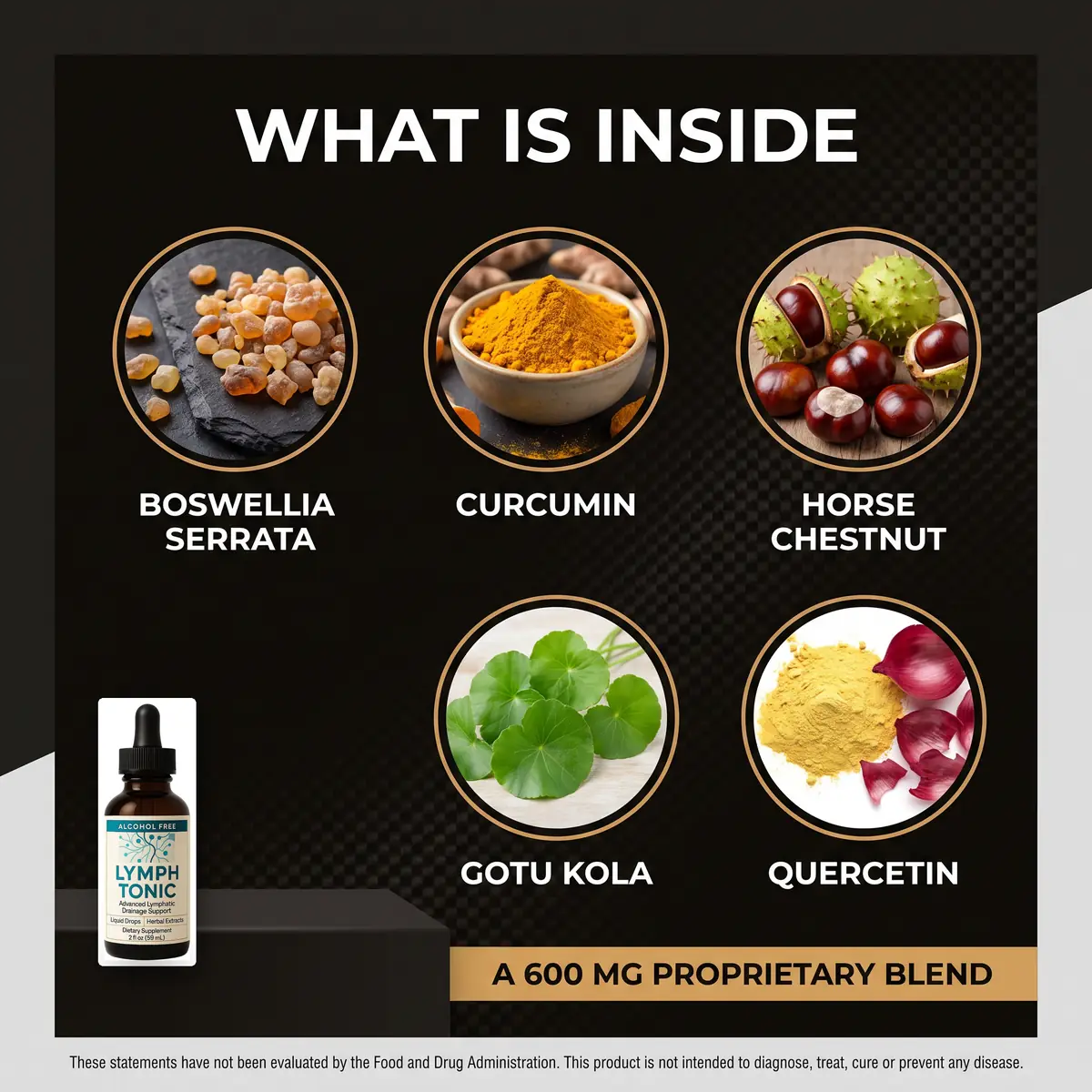
This guide explains the real boswellia serrata benefits in plain language, walks through exactly how boswellic acids work at the enzyme level, and shows you how to read a label so you can tell a serious standardised extract from a jar of ground resin. Boswellia is one of the thirteen actives in LymphTonic, and it earns its place for reasons worth understanding.
What boswellia serrata actually is
Boswellia serrata is a deciduous tree native to the dry hill forests of India. When the bark is scored, it weeps a gum resin that hardens into fragrant tears — the same botanical family that gives us the frankincense of history. That resin is not a single substance but a mixture: essential oils, gums, and, crucially, a set of triterpenic acids that carry the studied activity. When a supplement lists boswellia serrata, what matters is how much of the resin has been concentrated and purified into those active acids.
This is where the difference between spice and extract becomes real. Raw resin contains only a modest fraction of boswellic acids, and the proportion varies from harvest to harvest. A modern extract is processed to concentrate those acids to a known, guaranteed level. That is why the phrase “standardised to boswellic acids” is the single most useful thing you can look for — it turns a variable natural product into a consistent, measurable ingredient.
What are boswellic acids?
Boswellic acids are a family of pentacyclic triterpene acids found in the gum resin of the Boswellia tree, and they are the reason the resin is studied at all. An overview of Boswellia serrata as a potential anti-inflammatory agent sets out the resin’s composition and its traditional uses side by side.
Boswellic acids are a group of pentacyclic triterpenic acids — large, ring-shaped fat-soluble molecules. There are several of them, but four are usually named on technical sheets: beta-boswellic acid, acetyl-beta-boswellic acid, 11-keto-beta-boswellic acid (KBA), and the star of the group, 3-O-acetyl-11-keto-beta-boswellic acid, mercifully shortened to AKBA.
AKBA is the compound most researchers point to when they discuss boswellia’s activity. It is present in relatively small amounts in the total resin, which is why some premium extracts state not only their total boswellic acid content but also a separate, guaranteed AKBA percentage. If two products both claim 65 percent boswellic acids but only one guarantees a meaningful AKBA level, they are not really the same ingredient.
How boswellic acids work: the 5-LOX pathway
The mechanism most often attributed to boswellic acids is interference with 5-lipoxygenase, an enzyme that converts arachidonic acid into leukotrienes. That account is laid out in Ammon’s summary of boswellic acids and their role in chronic inflammatory diseases, which is also candid about where laboratory evidence outruns human evidence.
Here is the mechanism in plain terms. Your body produces a range of signalling molecules that turn its inflammatory response up and down. One important family is the leukotrienes, which are manufactured by an enzyme called 5-lipoxygenase, or 5-LOX. Leukotrienes are useful in short bursts, but when the pathway runs hot for too long it contributes to the kind of low-grade, lingering activation that wellness routines try to keep in check.
Boswellic acids — AKBA in particular — are studied for their ability to interact with the 5-LOX enzyme, moderating how briskly it churns out leukotrienes. This is a genuinely different mechanism from the one you may know from other botanicals. Curcumin, for instance, is best known for working through a signalling hub called NF-κB, which you can read about in our guide to curcumin and black pepper absorption. Because boswellia targets the 5-LOX/leukotriene route while curcumin leans on NF-κB, the two are complementary rather than redundant — a large part of why they so often share a bottle.
The takeaway for everyday wellness is simple: boswellic acids are thought to help the body keep its own inflammatory response in balance, rather than forcing it in one direction. That balanced-response framing is the honest, compliant way to describe what a food-derived triterpene does, and it is exactly the role boswellia plays inside a lymphatic and detox-support formula.
Boswellia, done properly, in one daily tonic
LymphTonic delivers boswellia serrata alongside curcumin, horse chestnut, gotu kola and nine more botanicals in an alcohol-free liquid — formulated for absorption and backed by a 60-day guarantee.
See LymphTonic Packages
Why boswellia sits well in a lymphatic formula
The lymphatic system is closely tied to how the body manages fluid, waste and inflammation. When tissues stay calm and comfortable, lymph tends to move more freely; when an area is chronically irritated, everything feels heavier and more congested. That is why botanicals associated with a balanced inflammatory response are a natural fit alongside the drainage-and-circulation actives in a detox tonic.
Boswellia sits in good company here. It pairs with the venotonic support of horse chestnut extract for legs and circulation and the connective-tissue role of gotu kola, so the blend touches inflammation, vein tone and tissue integrity from several angles at once. For the bigger-picture habits that keep everything moving, start with our overview of how to support lymphatic drainage naturally.
Dosing context and standardisation
Boswellia is one of the botanicals where the extract specification matters more than the raw weight. A pharmacokinetic assessment of Boswellia serrata in vitro, preclinical and clinical data found absorption varies widely between preparations — the practical reason to understand what a standardized extract means on a supplement label before comparing two products by milligrams alone.
Boswellia research typically uses standardised extracts rather than raw resin, and dosing in studies commonly falls in the range of a few hundred milligrams to around one gram of extract per day, split across doses. Because AKBA is the most-studied acid, some of the most interesting research uses extracts enriched for it specifically. There is no single “correct” number that fits every product — what matters is that the extract is standardised, so you know what you are getting.
Two practical points on standardisation:
- Total boswellic acids — a figure like “65% boswellic acids” tells you the extract is concentrated, not just dried resin.
- AKBA content — a separate, stated AKBA level (for example, an extra guaranteed percentage) signals a more refined, better-characterised ingredient.
Absorption: why boswellia likes fat and good delivery
Boswellic acids are fat-soluble, so they are absorbed more readily when taken with a little fat or delivered in a format designed to carry fat-soluble compounds. This is a recurring theme across the whole formula: fat-soluble and poorly-soluble actives need help getting into circulation. LymphTonic addresses this with black pepper extract and a phospholipid (phosphatidylcholine) base, an approach that echoes the logic behind our comparison of quercetin phytosome versus regular quercetin — different chemistry, same goal of turning a hard-to-absorb botanical into a usable one.
What to look for on the label
- “Boswellia serrata extract” — an extract, not simply “boswellia resin” or “frankincense powder.”
- A standardisation figure — a stated percentage of total boswellic acids, ideally with AKBA called out separately.
- An absorption strategy — a fat-based or phospholipid delivery, or a paired absorption enhancer, since the acids are fat-soluble.
- Sensible company — boswellia alongside complementary actives like curcumin, as it is in LymphTonic’s blend.

Safety notes
Boswellia serrata has a long history of traditional use and is generally well tolerated, with mild digestive upset being the most commonly reported niggle. As with any concentrated botanical, if you are pregnant or breastfeeding, take prescription medication, or have a medical condition, it is sensible to check with your doctor before adding a standardised boswellia supplement to your routine. This article is general information about a food-derived botanical, not medical advice, and boswellia is not intended to diagnose, treat, cure or prevent any disease.
Frequently asked questions
What is boswellia serrata used for?
Boswellia serrata, the source of the resin known as Indian frankincense, is traditionally used to support a healthy, balanced inflammatory response and comfortable joints and tissues. In modern supplements it is valued for its boswellic acids, which are studied for their role in that same balanced-response support. It is a general wellness botanical and is not intended to diagnose, treat, cure or prevent any disease.
What are boswellic acids and how do they work?
Boswellic acids are the family of pentacyclic triterpenic acids that give boswellia its activity. The most studied is AKBA (3-O-acetyl-11-keto-beta-boswellic acid), which interacts with the 5-lipoxygenase (5-LOX) enzyme pathway the body uses to produce inflammatory signalling molecules called leukotrienes. By moderating that pathway, boswellic acids are thought to help the body keep its inflammatory response in balance.
What does “standardised to boswellic acids” mean on a label?
Standardisation means the extract is guaranteed to contain a set minimum percentage of boswellic acids — commonly 65 percent total boswellic acids, and sometimes an additional guaranteed level of AKBA. This tells you how concentrated and consistent the extract is, rather than leaving you to guess from raw resin weight.
Is boswellia the same as frankincense?
They come from the same plant genus. Frankincense is the aromatic resin harvested from Boswellia trees; boswellia serrata is the specific Indian species most often used in supplements, and its purified resin extract is what delivers the boswellic acids.
Does boswellia need black pepper to be absorbed?
Boswellic acids are fat-soluble, so they are absorbed better when taken with some fat or in a well-designed delivery format. LymphTonic pairs boswellia with black pepper extract and a phospholipid base, which is a common way to help fat-soluble botanicals become more usable by the body.
- Siddiqui MZ. “Boswellia serrata, a potential antiinflammatory agent: an overview.” Indian Journal of Pharmaceutical Sciences. 2011. ncbi.nlm.nih.gov
- Ammon HP. “Boswellic Acids and Their Role in Chronic Inflammatory Diseases.” Advances in Experimental Medicine and Biology. 2016. pubmed.ncbi.nlm.nih.gov
- Abdel-Tawab M, et al. “Boswellia serrata: an overall assessment of in vitro, preclinical, pharmacokinetic and clinical data.” Clinical Pharmacokinetics. 2011. pubmed.ncbi.nlm.nih.gov
- National Center for Complementary and Integrative Health. “Boswellia.” NCCIH. nccih.nih.gov
† These statements have not been evaluated by the FDA. This product is not intended to diagnose, treat, cure or prevent any disease. This article is for general information only and is not medical advice.