How to Support Lymphatic Drainage Naturally: What Actually Moves Lymph
| The mechanism | Lymph has no pump. Muscle contraction, breathing and one-way valves are what move it. |
| Biggest lever | Breaking up long stretches of stillness — frequency beats intensity. |
| Overrated | Cleanse teas, sweat-it-out sessions and five minutes of dry brushing. |
| Where herbs fit | Vessel tone and fluid balance, as a complement to movement — not a substitute. |
The pump problem: why lymph only moves when you do
The lymphatic system is a one-way drainage network that collects fluid leaked from your capillaries, filters it through lymph nodes and returns it to the bloodstream near the collarbone — and unlike the circulatory system it has no heart driving it. The anatomy teaching modules on the lymphatic system published by the National Cancer Institute describe the arrangement plainly: vessels with internal valves, threaded between muscles, carrying roughly two to three litres of fluid a day in an adult.
That single anatomical fact explains almost every honest piece of advice on this page. Where blood is pushed, lymph is squeezed. Every calf contraction, every full breath, every stretch compresses the vessels running through the tissue, and the valves inside them make sure the fluid can only travel one way. Sit motionless for three hours and the machinery is not broken — it is simply idle.
It also explains why the language of “flushing” and “cleansing” misses the point. You are not clearing a blocked pipe. You are operating a pump that only runs while you are moving.
A day in the life of your drainage network
Rather than a list of habits to bolt on, it is more useful to see where an ordinary day already helps or hinders. What follows is the same twenty-four hours most people have, read through the lens of fluid movement.
Morning: the first thirty minutes
You wake up having spent seven or eight hours horizontal, which is the one stretch of the day when gravity is not working against you. Fluid that pooled in your legs during the evening has had all night to redistribute, which is exactly why faces look puffier in the morning and ankles look better. Standing up, walking, and drinking water re-establishes the normal gradient within the first half hour. A short walk before you sit down for the day does more for fluid movement than any single thing you can buy.
Working hours: the calf pump you keep forgetting
The soleus and gastrocnemius muscles in your calves are sometimes called the second heart, and for lymph they are arguably the first. Their contraction is the primary mechanical driver returning fluid from the lower limbs. A desk day removes that entirely. The fix is unglamorous and effective: stand up every forty-five minutes or so, do twenty slow heel raises, and take calls on your feet. Twelve short interruptions beat one heroic gym session, because it is the frequency of the squeeze that matters, not its magnitude.
Evening: elevation, warmth and a slower breath
By late afternoon most people have accumulated some fluid in the lower legs simply from being upright. Twenty minutes with your legs raised above hip height lets gravity do the work for free. Slow diaphragmatic breathing helps at the other end of the system: the thoracic duct, which returns most of the body’s lymph to the bloodstream, sits close to the diaphragm and is compressed and released with every deep breath. Six slow breaths, several times an evening, costs nothing.
Overnight: what sleep position actually changes
Lying flat removes the hydrostatic column that has been pressing fluid downward all day, and that redistribution is why so many people wake needing the bathroom. Raising the foot of the bed slightly can help stubborn ankle puffiness. What matters more is sleep duration and quality — short sleep raises circulating stress hormones and shifts sodium handling, both of which nudge the body toward holding water rather than releasing it.
Four popular drainage hacks that do less than claimed
Not everything marketed for lymphatic drainage earns its place. Being clear about the weak claims makes the strong ones more credible.
- Detox and cleanse teas. Most work as mild diuretics or laxatives. Losing water weight is not the same as improving drainage, and the rebound is usually swift.
- Sweating it out. Sweat is produced by sweat glands from blood plasma, not by the lymphatic system. A sauna feels wonderful and does not empty a lymph node.
- Five minutes of dry brushing. Harmless, pleasant, and mechanically trivial next to twenty minutes of walking. Keep it if you enjoy it; do not count on it.
- Single-session “drainage” treatments. Manual lymphatic drainage has genuine clinical use in trained hands for specific conditions. A one-off spa version, done casually, is a pleasant massage.
None of this is a reason for cynicism. It is a reason to spend your effort where the physiology actually responds.
Where botanicals genuinely fit — and where they do not
Herbs do not pump lymph. What some of them are studied for is the condition of the vessels and capillaries that lymph and blood travel through, and the inflammatory signalling around them. That is a narrower claim than most marketing makes, and it is the only one worth defending.
Horse chestnut is the most heavily researched of the group; the NCCIH overview of horse chestnut summarises the venous evidence along with its cautions, and the longer piece on horse chestnut extract for legs and circulation walks through the trials. Gotu kola comes at the same problem from the connective-tissue side: a pharmacological review of Centella asiatica collects the collagen and microcirculation work, covered in more depth in the article on gotu kola for connective tissue and circulation.
Citrus bioflavonoids are the third family worth knowing, studied for capillary permeability rather than for flow rate — the explainer on hesperidin methyl chalcone and vein support sets out what the human data does and does not cover. Curcumin and quercetin sit in a different bucket again, as antioxidants and inflammation modulators; a review of curcumin’s effects on human health is a fair starting point, and the primer on how antioxidants work and what oxidative stress means explains why that category is so often oversold.
Thirteen botanicals, one daily dropper
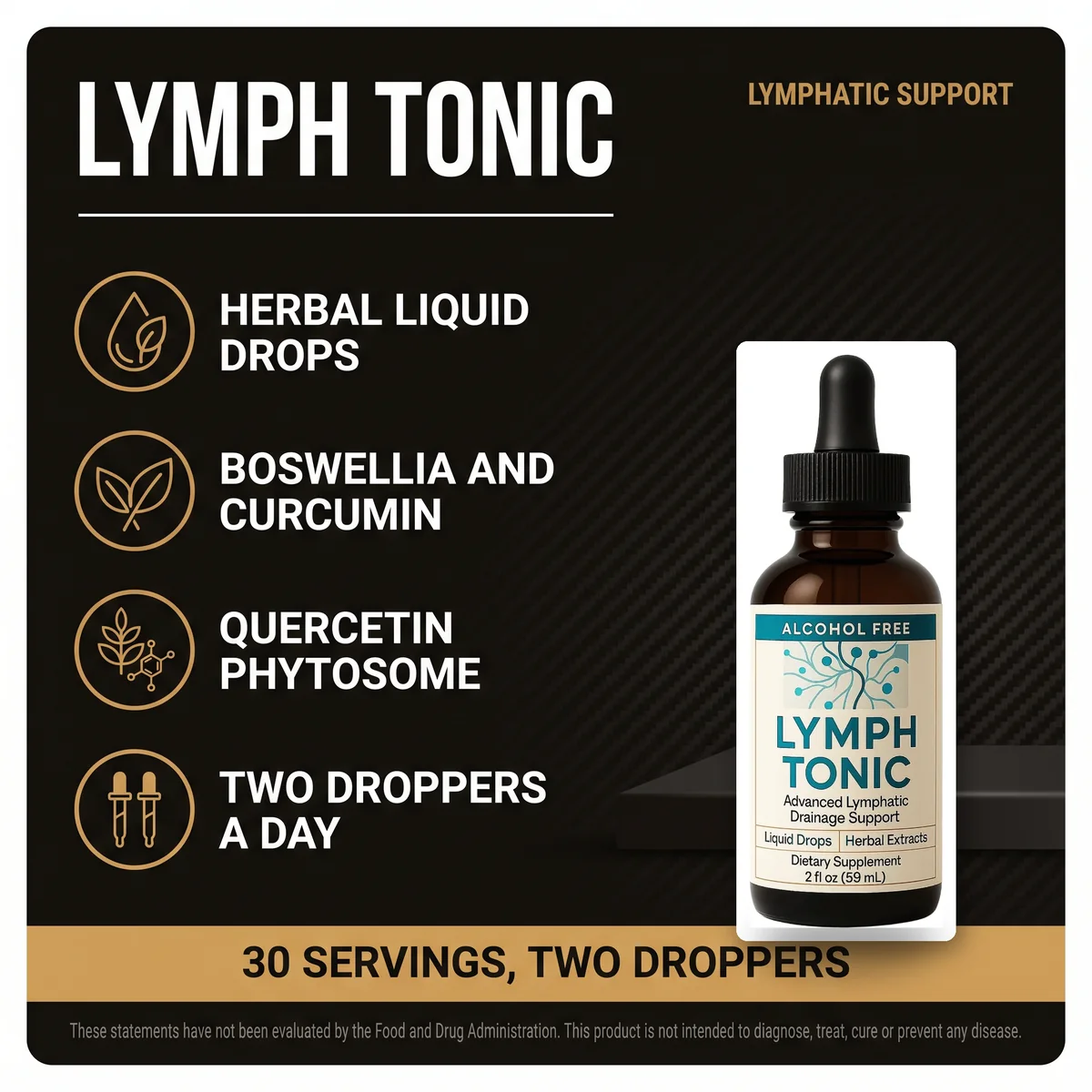
Lymph Tonic brings horse chestnut, gotu kola, hesperidin methyl chalcone, curcumin and nine more actives into a single alcohol-free liquid — a complement to the habits above, backed by a 60-day guarantee.
See Lymph Tonic PackagesBuild the routine you will still be doing in six weeks
The best lymphatic routine is the one that survives a busy week, and that almost always means attaching new behaviour to something you already do. Walk while the coffee brews. Do heel raises while the kettle boils. Take one call a day standing. Put your legs up while you watch something. Breathe slowly for a minute before you sleep. Five anchors, none of which requires a decision.
Two warnings are worth repeating. Swelling that is persistent, painful, one-sided, or accompanied by redness or breathlessness is not a lifestyle matter and needs a doctor, not a walk. And if you take anticoagulants, blood-pressure medication or are pregnant, check any herbal product with a pharmacist before starting — “natural” and “interaction-free” are unrelated ideas.
Frequently asked questions
What actually moves lymph through the body?
Skeletal muscle contraction, the pressure swing of deep breathing, and the one-way valves inside lymphatic vessels themselves. There is no central pump: lymph advances because the tissue around it is squeezed and released, which is why a still day leaves fluid sitting where it was.
How long does it take to notice a difference?
Fluid shifts respond within hours, so a single walk or an evening with your legs raised can change how your ankles feel by morning. Anything structural takes far longer, and consistent daily movement over several weeks is a fairer test than one intensive day.
Do lymphatic drainage massages and dry brushing help?
Light manual lymphatic drainage has real clinical use under a trained therapist, and dry brushing is pleasant and harmless. Neither, done casually at home for a few minutes, does much that a brisk walk does not do better and for longer.
Can a supplement replace movement for lymphatic support?
No. Botanicals such as horse chestnut, gotu kola and citrus flavonoids are studied for vessel tone and fluid balance, not for pumping lymph. They are a complement to movement, hydration and sleep, and are best judged on that modest basis.
- National Cancer Institute. “Introduction to the Lymphatic System.” SEER Training Modules. training.seer.cancer.gov
- National Center for Complementary and Integrative Health. “Horse Chestnut.” NCCIH. nccih.nih.gov
- Gohil KJ, Patel JA, Gajjar AK. “Pharmacological Review on Centella asiatica: A Potential Herbal Cure-all.” Indian Journal of Pharmaceutical Sciences. 2010. ncbi.nlm.nih.gov
- Hewlings SJ, Kalman DS. “Curcumin: A Review of Its Effects on Human Health.” Foods. 2017. ncbi.nlm.nih.gov
† These statements have not been evaluated by the FDA. This product is not intended to diagnose, treat, cure or prevent any disease. This article is for general information only and is not medical advice. As an affiliate we may earn a commission on purchases made through links on this page, at no extra cost to you.