Ginger Extract Benefits for Circulation and Digestion
| What it is | Ginger extract is a concentrated form of the ginger root (Zingiber officinale), rich in warming actives called gingerols and shogaols. |
| How it works | Those actives are studied as antioxidants and for supporting healthy circulation, comfortable digestion and a balanced inflammatory response. |
| Label check | Look for a standardised ginger extract (a stated % of gingerols), not just plain ginger powder. |
Ginger extract benefits for circulation and digestion: a kitchen classic, refined
Ginger is one of the few supplement ingredients you almost certainly already have in your kitchen. Yet the pungent root that warms a stir-fry or a cup of tea is also one of the most-studied botanicals in the world, with a traditional history stretching across Ayurvedic, Chinese and folk medicine. When it appears on a supplement label as a concentrated ginger extract, it is delivering the same warming compounds in a far more consistent, potent form — and it is one of the thirteen actives in LymphTonic.
This guide explains the real ginger extract benefits for circulation and digestion: what ginger’s active compounds are, how gingerols and shogaols work, why the herb bridges circulation, digestion and the inflammatory response, and how to read a label so you get a standardised extract rather than a scoop of dried powder.
What is ginger extract?
Ginger is the underground stem — the rhizome — of Zingiber officinale. A ginger extract concentrates the root’s active compounds, typically standardised so that each dose delivers a known amount of the molecules that matter. That standardisation is the key difference between a culinary spice and a supplement-grade ingredient: raw ginger’s potency varies with variety, growing conditions and age, whereas a standardised extract is characterised to a set level of actives.
Those actives fall into two closely related families, and knowing them is the whole story of how ginger works.
Gingerols and shogaols: ginger’s active compounds
Ginger’s activity is credited chiefly to gingerols in the fresh rhizome and to shogaols, which form when it is dried or heated. A survey of the bioactive compounds and bioactivities of Zingiber officinale catalogues both groups and the conditions that convert one into the other.
- Gingerols — the main pungent compounds in fresh ginger, of which 6-gingerol is the most abundant and best studied. They give raw ginger its sharp bite.
- Shogaols — formed when ginger is dried or heated, as gingerols lose a water molecule and convert into these even more pungent relatives. 6-shogaol is the headline compound here.
This fresh-versus-dried chemistry is why dried ginger tastes hotter and more concentrated than fresh, and why the ratio of gingerols to shogaols differs between products. Both families are studied as antioxidants that help neutralise free radicals, and for their interaction with the signalling the body uses to regulate its inflammatory response — the same balanced-response theme that runs through curcumin and boswellia. If you want that mechanism spelled out from another angle, our guide to curcumin and black pepper absorption explains the inflammatory-signalling picture in detail, and ginger belongs to the same family of dietary anti-inflammatory botanicals.
Ginger and circulation
Circulation claims for ginger rest mostly on small human trials and laboratory work rather than large outcome studies. A systematic review of ginger’s effects on human health is a fair way to see where the evidence is reasonable and where it thins out.
Ginger has a long reputation as a warming, circulatory herb — the sort of botanical traditional systems reach for to encourage a feeling of warmth and free-flowing movement. In a modern wellness context, that translates to support for healthy circulation, which is exactly why ginger sits so naturally beside the flow-and-drainage actives in a lymphatic tonic. Circulation and lymphatic drainage are two sides of the same coin: the cardiovascular system delivers and the lymphatic system reclaims, and both benefit from an internal environment that is warm, calm and moving.
This is where ginger earns its keep alongside the more specialised circulatory ingredients in the same bottle. It complements the vein-and-leg focus of horse chestnut extract and the blood-flow role of the enzyme covered in what nattokinase is and how it supports blood flow. Each works differently, but together they build a well-rounded circulation story.
Warming circulation support in one daily tonic
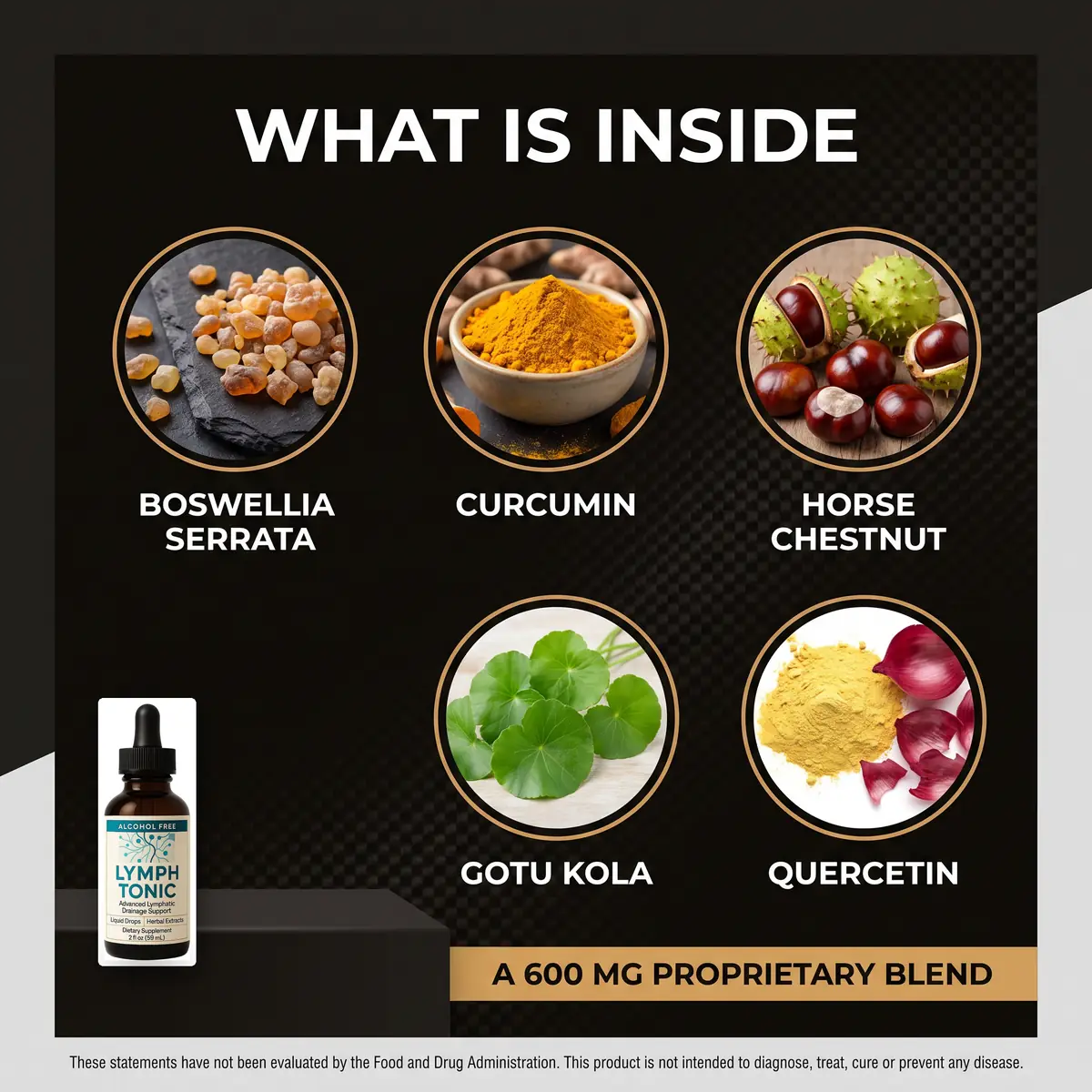
LymphTonic pairs ginger extract with curcumin, horse chestnut, nattokinase and nine more botanicals in an alcohol-free liquid — formulated for absorption and backed by a 60-day guarantee.
See LymphTonic Packages
Ginger and digestion
Digestive comfort is ginger’s oldest and best-supported use, from motion sickness to post-meal heaviness. The NIH Bookshelf chapter on the amazing and mighty ginger reviews that history alongside the modern pharmacology.
If ginger is famous for one thing, it is settling the stomach. It has one of the deepest traditional histories of any digestive herb, used across cultures to support comfortable digestion and to ease occasional queasiness and nausea. It is also one of the better-studied botanicals for that purpose, which is unusual for a folk remedy — the traditional reputation and the modern research point in the same direction.
Digestion matters more to a detox conversation than people assume. The gut is one of the body’s primary routes for processing and eliminating waste, and comfortable, well-functioning digestion is part of the foundation any “detox” routine actually rests on — far more than any dramatic cleanse. A herb that supports both circulation and digestion is doing double duty in a lymphatic formula, which is a large part of why ginger is included.
Dosing context and absorption
Ginger is used across a wide dose range, from small culinary amounts to the concentrated standardised extracts found in supplements. Research on ginger for various purposes commonly uses doses in the region of one to two grams of ginger per day, though a standardised extract delivers its actives at a much smaller weight because it is concentrated. There is no single universal figure, so the more useful marker is standardisation — a stated gingerol content tells you what you are actually getting.
Ginger’s actives are reasonably absorbable, but like most plant compounds they benefit from a well-designed delivery. LymphTonic carries ginger in an alcohol-free liquid base alongside black pepper extract and a phospholipid, the same absorption-first approach explained in our comparison of quercetin phytosome versus regular quercetin. For the everyday habits that support the whole system, see how to support lymphatic drainage naturally, or return to the LymphTonic homepage.
What to look for on the label
- A standardised extract — a stated percentage of gingerols (and ideally shogaols), not just “ginger root powder.”
- The botanical name — Zingiber officinale, confirming it is true culinary ginger.
- Sensible company — ginger alongside complementary circulation and antioxidant actives, as in LymphTonic’s blend.
Safety notes
Ginger is a common food and is generally well tolerated; the most frequent complaints are mild, such as a warm sensation or minor digestive upset at higher doses. Because ginger can have a mild effect on how the blood behaves, it is sensible to check with your doctor before using a concentrated ginger extract if you take blood-thinning medication, are pregnant, or are approaching surgery. This article is general information about a food-derived botanical, not medical advice, and ginger is not intended to diagnose, treat, cure or prevent any disease.
Frequently asked questions
What are the benefits of ginger extract for circulation?
Ginger is a warming botanical traditionally used to support healthy circulation and comfortable movement. Its active compounds, the gingerols and shogaols, are studied as antioxidants and for their role in supporting a balanced inflammatory response, which is why ginger is a natural companion to circulation and lymphatic-support ingredients. It is a general wellness botanical, not a drug.
What are gingerols and shogaols?
Gingerols are the main pungent compounds in fresh ginger, with 6-gingerol the most abundant. When ginger is dried or heated, gingerols convert into shogaols, which are even more pungent. Both groups are the actives researchers focus on when studying ginger’s antioxidant and digestive effects.
Does ginger help digestion?
Ginger has one of the longest traditional histories of any digestive herb. It is widely used to support comfortable digestion and to ease occasional nausea and queasiness, and it is one of the better-studied botanicals for settling the stomach. As always, this describes traditional and general use, not a medical treatment.
What should I look for in a ginger extract on a label?
Look for a ginger extract that is standardised to its actives — commonly a stated percentage of gingerols (and sometimes shogaols) — rather than plain ginger powder alone. A standardised extract tells you the product delivers a consistent, concentrated dose of the compounds that carry ginger’s activity.
Why is ginger in a lymphatic supplement?
Lymphatic and detox support is closely tied to circulation, digestion and a balanced inflammatory response. Ginger touches all three: it is a warming circulatory herb, a classic digestive aid, and an antioxidant, so it complements the other botanicals in a lymphatic tonic like LymphTonic.
- Mao QQ, et al. “Bioactive compounds and bioactivities of ginger (Zingiber officinale Roscoe).” Foods. 2019. ncbi.nlm.nih.gov
- Anh NH, et al. “Ginger on human health: a comprehensive systematic review.” Nutrients. 2020. ncbi.nlm.nih.gov
- Bode AM, Dong Z. “The Amazing and Mighty Ginger.” In: Herbal Medicine: Biomolecular and Clinical Aspects. 2011. ncbi.nlm.nih.gov
- National Center for Complementary and Integrative Health. “Ginger.” NCCIH. nccih.nih.gov
† These statements have not been evaluated by the FDA. This product is not intended to diagnose, treat, cure or prevent any disease. This article is for general information only and is not medical advice.